A GPU partition changes the baseline
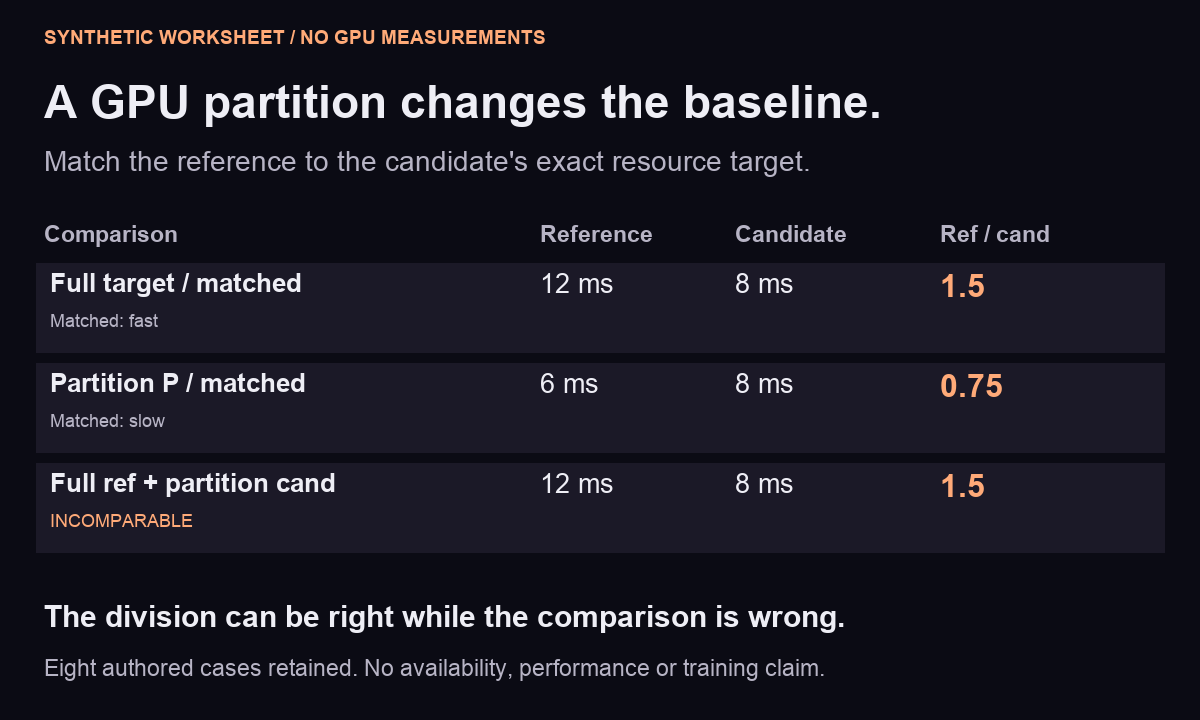
Original Nodus research: A GPU partition changes the baseline.
This is a fictional timing example: an 8 ms candidate against a 12 ms full-target reference gives 1.5×. On partition P, a 6 ms matched reference against an 8 ms candidate gives 0.75×.
Both comparisons can be internally consistent. Mixing the full-target reference with the partition candidate keeps the arithmetic 12 / 8 = 1.5, but removes the matched target. It does not show that the candidate beats its partition baseline.
One reviewed local CPU run of the original Nodus worksheet retained all eight authored cases and matched eighteen boundary controls. The result preserves all timing triples. It is a Python standard-library teaching artifact, not a hardware measurement or training result.
Name the resources
The NVIDIA MIG guide, release 620 distinguishes GPU instances from compute instances. Record both. Compute instances within a GPU instance share its memory and engines; do not turn a short profile name into a blanket isolation claim.
The current MPS documentation distinguishes dynamic active-thread limits from static SM partitions. The first does not reserve dedicated resources. Static mode is a separate configuration and ignores dynamic provisioning limits. Pin the actual mode, driver and resource allocation. This article asserts no Nodus profile availability.
Decide what disagreement means
One fictional row changes sibling load while preserving partition P. Its label differs from the no-sibling row. This illustrates a disagreement across conditions, not a measured isolation failure or proof of faulty timing.
If the reward objective is isolated performance, keep that objective fixed when checking loaded evaluations. If the objective is loaded performance, preserve the specified load. Neither objective can silently replace the other.
Preserve the boundary cases
A 10 ms reference and 9.9 ms candidate each have an invented absolute error bound of 0.2 ms. Their ratio envelope crosses the illustrative decision boundaries, so the row remains ambiguous. The preselected 1% band is not a universal threshold. Error bounds are not confidence intervals, and identical authored repeats estimate no variance.
Wrong outputs and unfinished work stay in the complete plan without an eligible performance result. All reward fields remain null. The worksheet checks declared identity and arithmetic; it cannot authenticate a timer, a grader or data rights.
For a real study, freeze task and source identity, verify correctness independently, interleave timing order, retain raw synchronized pairs and report load strata separately. Cost and downstream learning claims need separate evidence.
Download the worksheet and retained result. Read all eight results.
About the author
- Founder @ Nodus Compute
Comments
Join the discussionNo comments yet. Be the first to comment.